


What is a rip current?
Rip currents are powerful channels of water that flow away from shore.
A rip current is a narrow, fast-moving channel of water that flows away from the beach — and knowing how to survive one using the Smart Surfers Way starts with understanding exactly what a rip current is. Rip currents form when waves push water toward the shore and that water needs to find a way back out to sea. Instead of spreading evenly, the water channels into a concentrated stream — sometimes moving faster than an Olympic swimmer can swim.
Rip currents can form on any beach with breaking waves — on the East Coast, West Coast, Gulf Coast, and even along the shores of the Great Lakes.
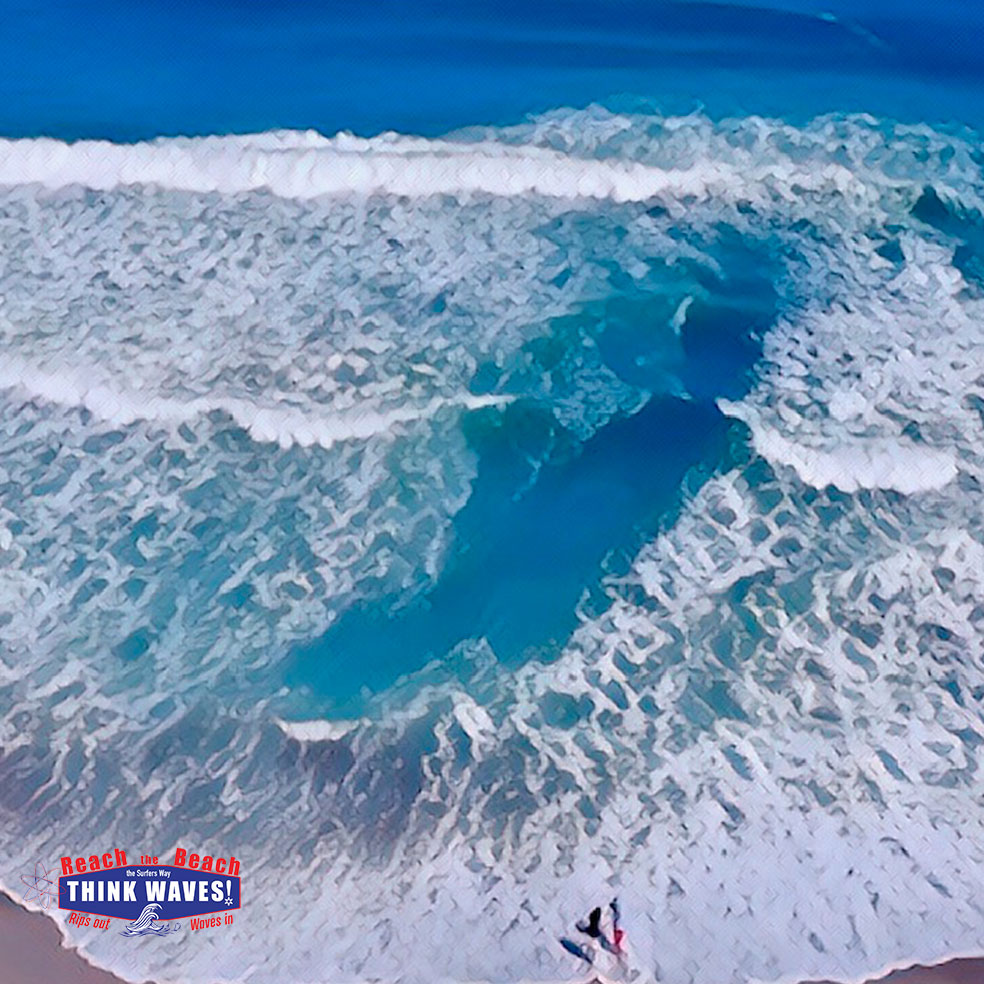
What causes a rip current?
Rip currents are created by a combination of waves, tides, and the shape of the seafloor. Here is how they form:
- Waves push water toward the beach. As waves break near shore, they push large volumes of water toward the beach.
- Water gets trapped. Sandbars, jetties, piers, and the natural shape of the ocean floor trap water along the shoreline.
- Water finds a gap and rushes out. The trapped water forces its way back through gaps in sandbars or along the sides of structures — creating a fast-moving channel heading offshore.
The bigger the waves, the stronger the rip current. Rip currents can move at up to 8 feet per second — faster than most people can run.
How common are rip currents?
Rip currents are far more common than most beachgoers realize:
Rip currents are responsible for over 80% of all lifeguard rescues at surf beaches, according to the United States Lifesaving Association (USLA).
The USLA estimates that rip currents cause more than 100 drowning deaths per year in the United States.
Since 2010, over 800 people in the U.S. have lost their lives to rip current drownings, according to NOAA data.
Rip currents are present on many beaches every day of the year — most are too weak to be dangerous, but conditions can change rapidly.
Rip currents are the leading cause of surf zone fatalities in the United States — more deadly than sharks, jellyfish, or any other ocean hazard.
Why do rip currents become deadly?
Rip currents themselves do not pull swimmers underwater. They do not drag people to the bottom of the ocean. A rip current moves horizontally — away from shore — not downward.
The danger comes from what happens next.
When a swimmer is caught in a rip current, panic sets in. They instinctively try to swim straight back to shore — directly against the current. Fighting the current leads to exhaustion. Exhaustion leads to drowning.
According to NOAA’s National Weather Service, drowning in a rip current occurs when a person panics, lacks water skills, or becomes too exhausted to stay afloat after fighting the current.
This is exactly what Think Waves and the Smart Surfers Way are designed to prevent.
What do experienced surfers know about rip currents?
Here is what most people do not know: experienced surfers do not fear rip currents — they use them.
For hundreds of years, surfers have used rip currents as a free ride out past the breaking waves. Instead of paddling against the surf to reach the lineup, surfers position themselves in a rip current and let it carry them effortlessly offshore. Once beyond the breaking waves, they catch a wave back to shore.
Rips take you out. Waves bring you back in.
This is the foundation of the Smart Surfers Way — the rip current survival method taught by Think Waves Lifesaving Organization. Knowing what to do if caught in a rip current can save your life. And experienced surfers have known the answer for hundreds of years.
How do you spot a rip current?
Rip currents can be difficult to spot — even experienced lifeguards sometimes miss them. But there are visual clues to look for:
Choppy, discolored water — a rip current often appears darker or a different color than surrounding water
A gap in the breaking waves — rip currents form where waves are not breaking, creating a calm-looking corridor
Foam or debris moving offshore — watch for floating material moving steadily away from shore
Churned-up sandy water — sediment stirred up by the current can create a murky streak heading out to sea
The easiest rule: look for the breaking waves. Rip currents flow between or alongside breaking waves — where the waves aren’t breaking is where the rip is running.
What should you do if caught in a rip current?
The most important thing to do is stay calm.
A rip current will not pull you underwater. It will carry you offshore — past the breaking waves — and then weaken. The Surfers Way teaches the most intuitive escape method:
- Stay calm — do not panic, do not fight
- Flow with the current — let it carry you offshore
- Swim toward the nearest breaking waves — waves will push you back to shore
Do not swim straight back to shore against the current. You will exhaust yourself. Instead, angle your swim toward the nearest breaking waves and let the ocean’s natural energy bring you in.
“Think Waves Teaches the Smart Surfers Way”
Think Waves Lifesaving Organization (TWLO) is a 501(c)3 nonprofit dedicated to ocean safety education. Our mission is to remove the panic, fear, and misinformation surrounding rip currents and replace it with clear, accurate knowledge proven by hundreds of years of surfing experience.
We work alongside the United States Lifesaving Association (USLA) and the National Oceanic and Atmospheric Administration (NOAA) to improve water safety worldwide.
The Smart Surfers Way is the world’s most intuitive rip current self-rescue technique — and it starts with understanding exactly what a rip current is and why it is not your enemy.
Take the free Rip Current Quiz →
Support our mission — Donate today →
Copyright @ Think Waves Lifesaving Organization / the Surfers Way / 2024.