
How to Escape a Rip Current
The Smart Surfers Way: the world’s most intuitive rip current self-rescue technique
The Smart Surfers Way is a rip current self-rescue technique that experienced surfers have used for hundreds of years. It is simple, it is intuitive, and it works — because it works with the ocean rather than against it.
Most people are never taught how to escape a rip current correctly. When they get caught in one, instinct takes over — and instinct says swim back to shore as fast as possible. That instinct is wrong, and it is what causes the exhaustion that leads to drowning.
Think Waves Lifesaving Organization teaches the Smart Surfers Way so that every person who goes to the ocean — swimmer, surfer, or beachgoer — has a survival plan before they ever need it.
The one rule that could save your life
Everything about survivin a rip current comes down to one rule:
Never swim against a rip current.
Rip currents can move faster than an Olympic swimmer. NOAA’s National Weather Service has recorded rip currents reaching speeds of 8 feet per second — faster than any competitive swimmer on record. No matter how strong you are, you cannot outswim a rip. Every second you spend fighting it is energy you will never get back.
The moment a swimmer begins fighting a rip current head-on, the outcome is almost always the same: rapid exhaustion, loss of buoyancy, and drowning. This is not a lack of strength — it is physics.
The Smart Surfers Way to escape a rip current works because it replaces that fatal instinct with a simple, practiced plan to escape.
The 3-step Smart Surfers Way escape a rip current
These are the three steps of the Smart Surfers Way. Learn them before you go to the beach.
Step 1: Stay calm — the current will not pull you under
A rip current moves horizontally, away from shore. It will not drag you to the bottom. It will carry you offshore, and then it will weaken. Your job in the first seconds is to override the panic response — breathe, stay afloat, and do not fight.
Dr. Jamie MacMahan, professor of oceanography at the Naval Postgraduate School and one of the world’s leading rip current researchers, has jumped into rip currents around the world to study their behavior firsthand. His conclusion: “If you can relax — and it’s a long time, for maybe three minutes — you’re generally going to float back to the beach.”
Staying calm is not passive — it is the single most effective action you can take.
Step 2: Flow with the current — let it carry you offshore
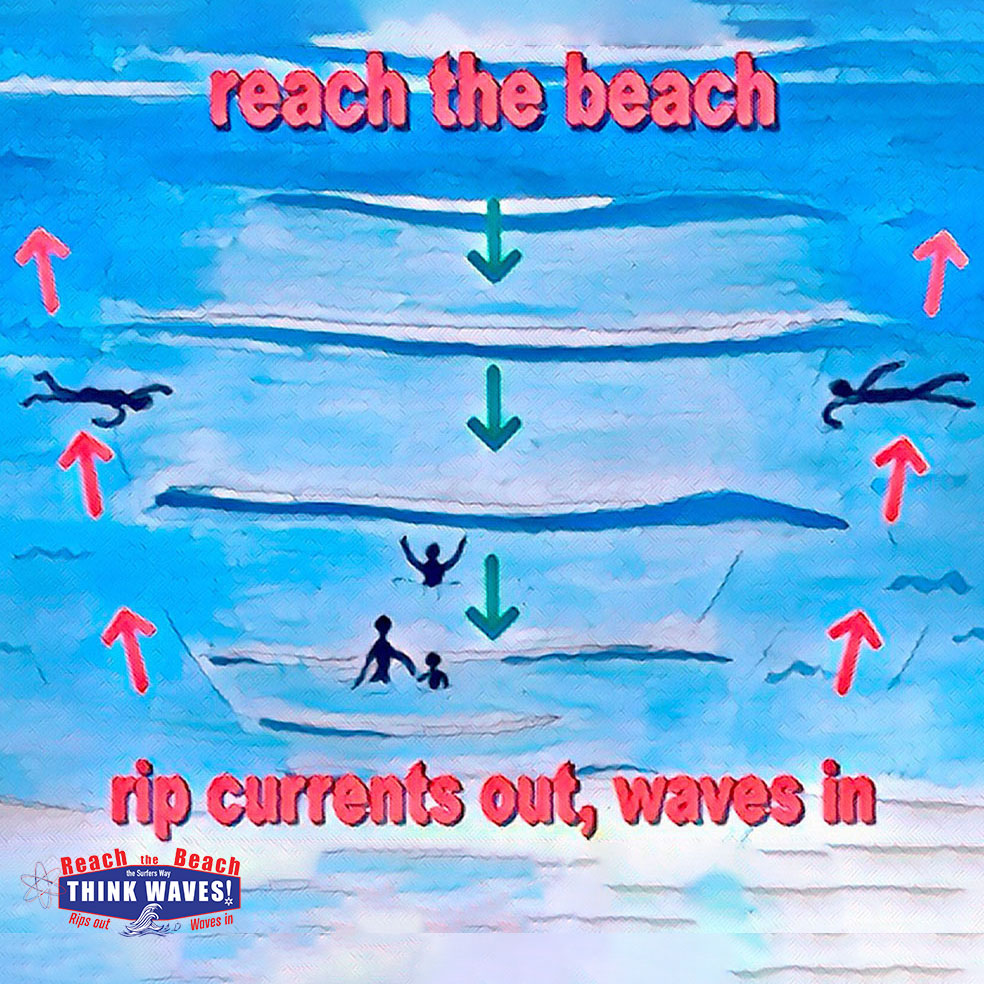
Do not fight the direction the current is taking you. Let it carry you out. This feels deeply wrong — everything in you wants to go toward shore — but the rip is carrying you toward breaking waves, and breaking waves carry energy back toward shore. The rip current itself with help you escape a rip current.
MacMahan’s GPS drifter research, published in Marine Geology, tracked rip currents on beaches in the United States, France, and England. He found that 80–90% of rip currents flow in circulation patterns — not straight out to sea. A swimmer who floats and does not fight has an 80–90% chance of being returned toward shore within three to six minutes.
This is what surfers have always known. Surfers call it “riding the rip” — a free paddle to the lineup. The current takes you out; the waves bring you back.
Step 3: Swim toward the nearest breaking waves
Once you feel the current weaken — or once you can see breaking waves nearby — swim toward them. Breaking waves carry energy toward shore and will assist your return. Swim diagonally toward the waves, not straight back to shore, and not parallel to the beach unless you are certain you are outside the current and can see the clearest path.
If you cannot reach the waves and the current is still moving, continue to float and conserve energy. Signal for help by raising one arm and waving toward shore. Do not exhaust yourself — a resting swimmer stays afloat far longer than a fighting one.
What about swimming parallel to shore to escape a rip current?
For decades, the standard advice to escape a rip current has been: swim parallel to shore to escape the current, then swim back to the beach. This advice is not wrong — but it is incomplete, and it can sometimes make things worse.
Research by Dr. MacMahan found that because many rip currents circulate in eddies, swimming parallel to shore has roughly a 50/50 chance of sending a swimmer directly into the feeder current — the parallel flow that feeds the rip. This can push the swimmer back into the rip, causing exhaustion without progress.
A Charles Darwin University study analyzing strategies to escape a rip current found that in more than 75% of flow scenarios, the “do nothing” — float and ride — strategy outperformed swimming parallel.
The Smart Surfers Way to escape a rip current prioritizes floating and riding the current toward breaking waves. If you are a confident swimmer and can clearly see the edge of the current, swimming parallel is an option — but float first, assess, and never waste energy thrashing.
If you see someone else caught in a rip — do not enter the water
Every year, people die trying to rescue rip current victims without a flotation device. NOAA data shows that approximately 27% of rip current drowning deaths involve bystanders who entered the water unaided to help someone else escape a rip current.
Australian research from Surf Life Saving Australia found that 97% of fatal bystander rescuers did not bring a flotation device into the water with them.
If you see someone caught in a rip:
- Call 911 immediately — or send someone to get a lifeguard
- Throw something that floats — a surfboard, boogie board, cooler, pool noodle, or any floating object
- Yell instructions — “Don’t fight it! Float! Raise your arm!”
- Do not enter the water without a flotation device and the ability to rescue safely
Your calm voice from shore is more valuable than your body in the water.
Before you go to the beach — prepare now, not after
The Smart Surfers Way is built on preparation. The time to learn these steps is before you ever need them — not in the middle of a rip current.
Here is what to do before your next beach day:
Check the NOAA beach forecast at weather.gov for rip current risk at your local beach
Know the visual signs of a rip current before you enter the water — learn how to spot a rip current →
Swim near a lifeguard — the chance of drowning at a lifeguarded beach is 1 in 19 million (NOAA/USLA)
Share the Smart Surfers Way with everyone who goes to the beach — children, parents, and friends
Never swim alone — always have someone on shore who can call for help
Think Waves teaches how to escape a rip current to the world
Think Waves Lifesaving Organization (TWLO) is a 501(c)3 nonprofit based in California. Our mission is to remove the fear associated with rip currents and replace it with knowledge — the knowledge that saves lives.
The Smart Surfers Way is endorsed by Lifeguard Captain Mike Hutchinson as the world’s best intuitive rip current self-rescue technique. It is the same method experienced surfers have trusted to escape a rip current for hundreds of years. And now it belongs to everyone.
Take our free Rip Current Quiz to test your knowledge of rip current safety, including how to escape a rip current — and share it with everyone who goes to the ocean.
Are rip currents dangerous? Learn why →
How to spot a rip current →
Take the free Rip Current Quiz →
Support our mission — Donate today →